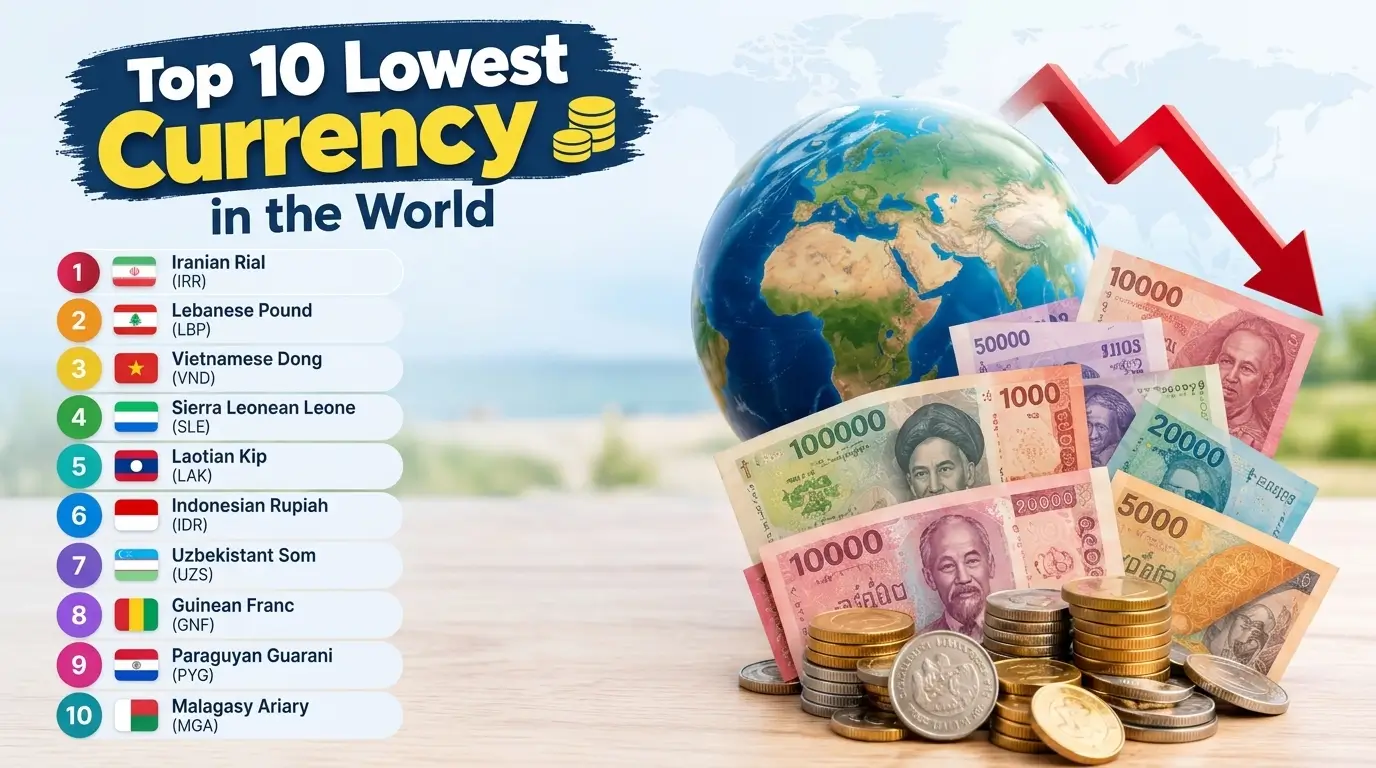
Currencies are one of the most important indicators of a country’s economy and its position in international trade. Not all currencies are created equal. While the US dollar, euro, and British pound dominate global trade, some national currencies have fallen so far in value that it takes hundreds of thousands — even millions — of units to equal a single US dollar. Below is a rundown of the ten weakest currencies in the world in 2026 and the economic stories behind their decline.
| Rank | Currency | Country | Currency Code |
| 1 | Iranian Rial | Iran | IRR |
| 2 | Lebanese Pound | Lebanon | LBP |
| 3 | Vietnamese Dong | Vietnam | VND |
| 4 | Sierra Leonean Leone | Sierra Leone | SLE |
| 5 | Laotian Kip | Laos | LAK |
| 6 | Indonesian Rupiah | Indonesia | IDR |
| 7 | Uzbekistani Som | Uzbekistan | UZS |
| 8 | Guinean Franc | Guinea | GNF |
| 9 | Paraguayan Guarani | Paraguay | PYG |
| 10 | Malagasy Ariary | Madagascar | MGA |
Not necessarily. This is one of the biggest misconceptions about currency rankings. For example, the Vietnamese dong and Indonesian rupiah have high numerical values per US dollar, but Vietnam and Indonesia have large and diverse economies.
There is no single lowest currency in the world. The most lowest currency by nominal exchange value is the Iranian rial (IRR), Lebanese Pound (LBP), Vietnamese Dong (VND), Sierra Leonean Leone (SLE), and Laotian Kip (LAK).
